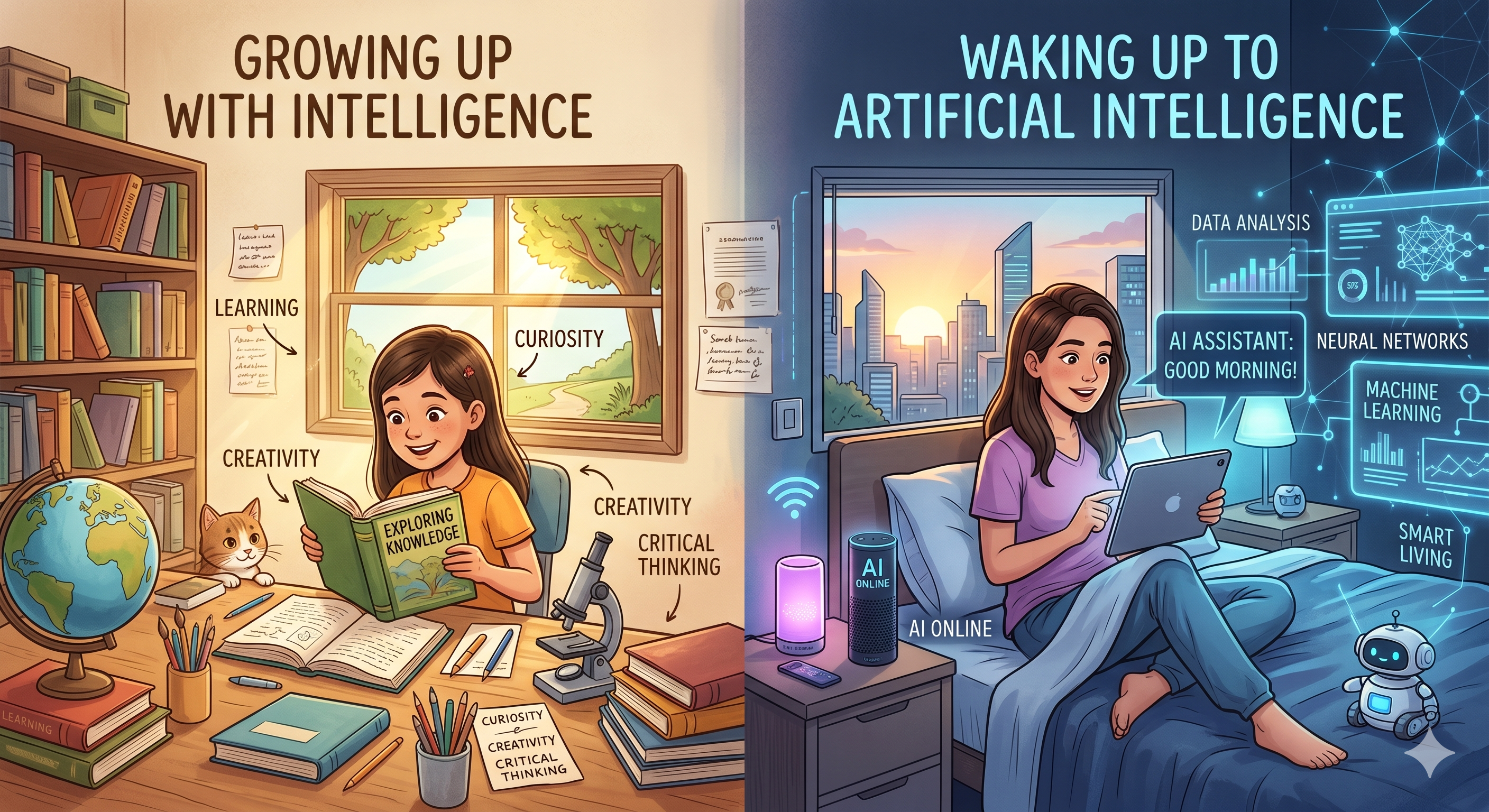
Think about the first time you heard the word intelligence. For most of us, it was not a big or confusing idea. Intelligence meant the student who answered questions quickly in class, a parent who gave good advice, or a friend who understood how you felt without you saying much. Intelligence felt human. It came from learning, making mistakes, asking questions, and caring about others.
As children, many of us also grew up watching movies where robots worked for people, cities ran smoothly with the help of technology, and machines handled everyday tasks. These scenes felt exciting and futuristic, but they also felt far away. They belonged to a world that did not seem real or possible.
Now take a moment and look around your own life.
As we move into 2026, that future no longer feels distant. Your phone can talk back to you. Apps suggest what you might want to watch, buy, or read. Cars are learning how to drive on their own. What once felt like science fiction has quietly become part of daily life, almost without us noticing.
If this change makes you feel curious, amazed, and a little uncomfortable at the same time, that reaction is completely normal. Many people feel the same way.
When the World Started to Change
Most of us were raised in a world shaped by human intelligence. People made decisions after talking things through. Teachers, doctors, parents, and leaders relied on experience, emotions, and judgment. Even when mistakes happened, they were human mistakes, made with good intentions.
Today, many decisions are helped or sometimes even made by machines. These machines do not feel emotions or doubt themselves. They do not get tired or confused. They work quickly, using data and patterns to choose what comes next.
This change did not happen all at once. It entered our lives slowly. First through helpful tools, then through suggestions, reminders, and automation. Over time, the world began to feel less emotional and more technical. Not colder, but more exact.
This quiet shift is largely because of Artificial Intelligence.
What Is Artificial Intelligence, in Simple Terms
Artificial Intelligence (AI) is technology that allows machines to learn from experience and make choices without being told exactly what to do every single time.
Think about how you learned to ride a bicycle, play a sport, or solve a math problem. You probably did not succeed on the first try. You fell, made mistakes, and tried again. Slowly, you understood what worked and what did not.
AI learns in a similar way. Instead of learning from life experiences, it learns from data. The difference is that AI can look at huge amounts of information and learn much faster than humans can.
From Following Rules to Learning Patterns
Older computer programs worked by following strict rules. They were like recipes that had to be followed step by step. If something unexpected happened, the program could not adjust.
Artificial Intelligence works differently. It learns from examples instead of fixed rules. Imagine a cook who has prepared many meals over the years. They do not need to read a recipe every time. They understand how flavors work and can adjust when something goes wrong.
This type of learning is called machine learning. It allows computers to notice patterns in data, learn from mistakes, and improve over time instead of staying the same.
How AI Technology Is Part of Your Everyday Life
Even if you do not think about it often, AI technology is already part of your everyday routine.
When you ask ChatGPT, Alexa, or Siri a question, AI is working behind the scenes to understand your words and respond. When your phone unlocks by recognizing your face, that is facial recognition technology. When apps like Netflix, YouTube, or Spotify suggest something that feels surprisingly accurate, those suggestions come from AI-powered recommendation systems.
AI is also used beyond phones and computers. Self-driving cars are learning how to move safely on real roads by watching traffic, signs, and people. Creative tools use AI image generation to turn words into pictures and designs. In games like chess and Go, AI systems have learned strategies so advanced that even experts study them.
Because these tools work quietly in the background, they often feel normal. Yet they are powerful and continue to shape how we live.
How Does Artificial Intelligence Learn?
AI learns through machine learning, which means it improves by studying many examples.
Imagine teaching a child how to tell the difference between cats and dogs. You show pictures, point out mistakes, and repeat the lesson. Over time, the child begins to recognize the difference without help.
AI learns the same way. It might study thousands or even millions of labeled images. When it sees a new image, it compares it to what it already knows and makes a choice. Each time it is corrected, it becomes a little better.
The more data AI sees, the smarter and more accurate it becomes.
Why Artificial Intelligence Feels So Personal
Artificial Intelligence feels different from older technology because it affects real people in real ways. It plays a role in schools, jobs, healthcare, entertainment, and creativity.
AI does not have feelings, dreams, or emotions. Yet its decisions can affect opportunities, outcomes, and choices. This leads many of us to wonder what happens when machines become better at deciding than humans.
The concern is not only about machines replacing work. It is about keeping kindness, fairness, and understanding important in a world that values speed and efficiency.
A Choice We All Share
AI itself is neither good nor bad. It depends on how people choose to use it. When used carefully, Artificial Intelligence can help people focus on creativity, reduce boring or repetitive tasks, and solve problems that are too big for humans alone.
However, if we rely on AI without thinking, we risk losing the human touch that gives intelligence meaning. Balance is important.
The Future of AI
The future of AI is still being written. New tools will appear, and technology will continue to grow. What matters most is how people guide that growth.
When humans stay involved, ask questions, and set boundaries, AI can become a helpful partner rather than a replacement.
Conclusion
We are living in a time of great change. Intelligence is no longer only human, but how it is used remains our responsibility.
Technology will keep growing. The important question is whether we grow wiser with it.
The future of Artificial Intelligence will be shaped not just by machines, but by the values, choices, and care of the people who use them.

