
Why Traditional Marketing Still Matters More Than You Think
The types of traditional marketing continue to play a critical role in how brands build trust and recognition. While modern marketing focuses on digital platforms, traditional methods remain deeply rooted in human behaviour and real-world interactions.
Before the rise of online channels, businesses relied on offline strategies to connect with audiences. These methods were designed around:
- Visibility through repeated exposure
- Repetition to build familiarity
- Emotional connection to resonate with audiences
Even today, they continue to deliver strong results because they reach people beyond digital screens—marketing that has created a legacy of winning people's hearts.
According to a global study by Nielsen, traditional advertising channels such as television and print are still among the most trusted forms of advertising.
So, today in this guide you are going to understand different types of marketing which helps businesses create balanced strategies. At the same time, focusing on the types of traditional marketing ensures long-term brand recall and credibility.
Word of Mouth Marketing
"It never happened that I have not used the brand my best friend has recommended! With you too?"
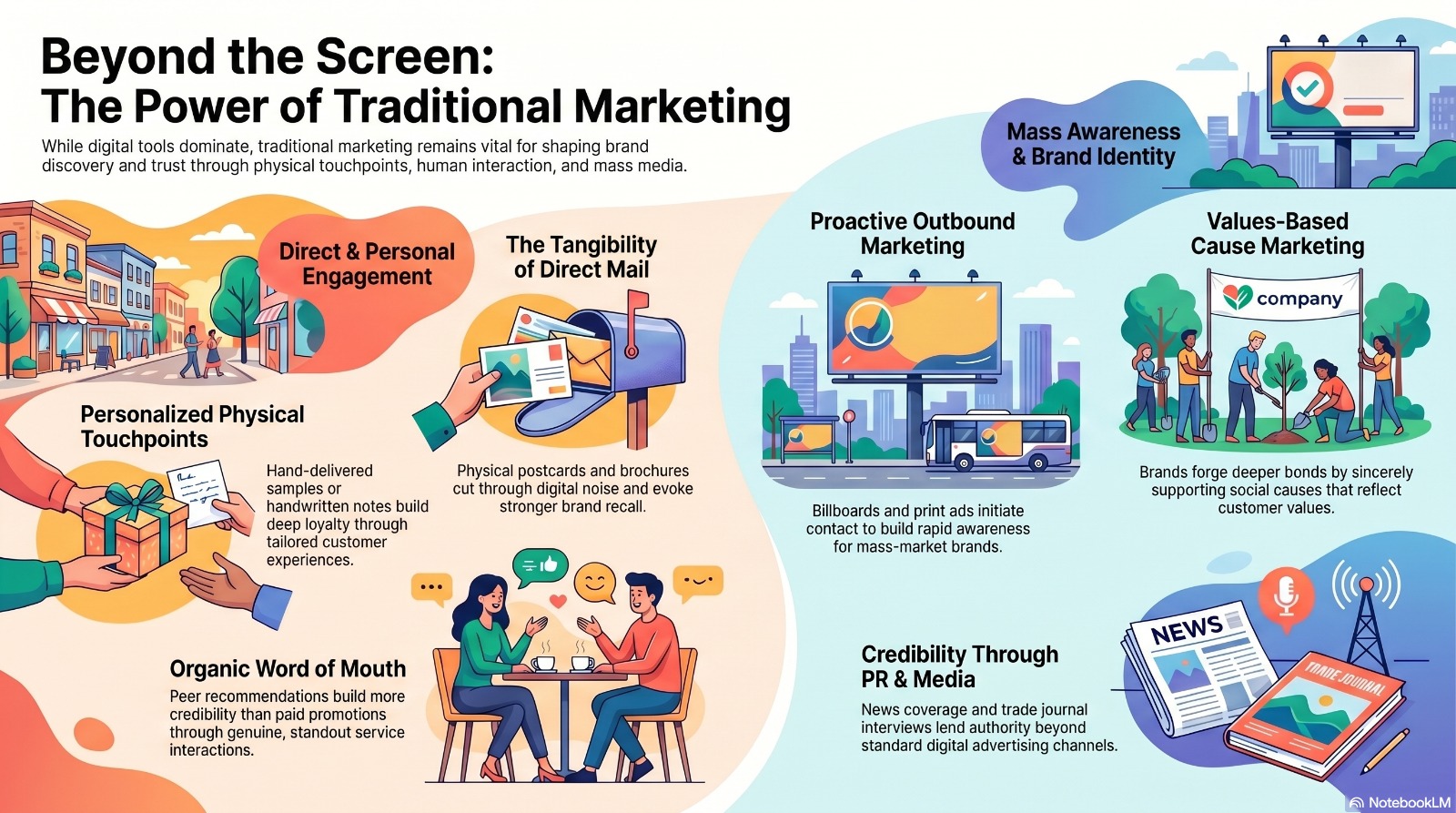
Word of mouth is one of the most reliable types of traditional marketing because it is built on trust. People tend to believe recommendations from friends, family, and colleagues more than any advertisement.
This form of marketing depends entirely on customer experience. When customers are satisfied, they naturally share their opinions, which leads to organic growth. This makes it a valuable part of broader types of marketing strategies.
A strong example is Urban Company, which focused on service quality and customer referrals to grow its user base. Similarly, Dropbox expanded rapidly through a referral program.
The main advantage is credibility and authenticity. However, it is not fully controllable and requires consistent service quality to sustain growth.
Brand Marketing
Brand marketing focuses on creating a long-term identity that customers recognise and trust. Among the many types of traditional marketing, this approach builds emotional connection rather than immediate sales.
It ensures that a brand stays in the customer's mind over time. This is why it remains one of the most effective types of marketing for long-term success.
For example, Harley-Davidson represents freedom and individuality beyond just its products. Similarly, Tata Group has built a strong reputation for reliability.
The benefit is strong brand recall and loyalty. The limitation is that it requires time, consistency, and investment to deliver results.
PR Marketing
Public Relations focuses on building credibility through media coverage and public visibility. It is one of the most trusted types of traditional marketing because it relies on earned recognition instead of paid promotions.
PR plays a key role in shaping how a brand is perceived by the public. It strengthens authority, which is essential across different types of marketing.
A well-known example is BYJU'S, which gained visibility through media features and thought leadership before scaling its advertising efforts.
The advantage of PR is high credibility and long-term impact. However, it offers limited control compared to paid campaigns and requires consistent effort.
Personalised Marketing
Personalised marketing focuses on delivering tailored communication based on customer preferences. While widely used today, its core idea has always been part of traditional customer-focused approaches.
It remains one of the most effective types of marketing because it increases relevance and engagement. Even within the types of traditional marketing, understanding the customer has always been essential.
A strong example is Amazon, which recommends products based on user behaviour.
The main advantage is improved customer experience and higher conversions. The challenge lies in maintaining accurate data and avoiding over-personalisation.
Cause Marketing
Cause marketing connects a brand with a social or environmental purpose. It is one of the most impactful types of traditional marketing for building emotional engagement.
This approach allows brands to go beyond selling and focus on values that resonate with their audience. It has become an important part of modern types of marketing strategies.
For instance, Patagonia promoted sustainability through its campaign encouraging responsible consumption.
In India, Tata Tea created awareness through the "Jaago Re" campaign.
The advantage is strong emotional connection. However, authenticity is essential, as misalignment can affect trust.
Partner Marketing
Partner marketing involves collaboration between brands to reach a wider audience. It is one of the most strategic types of traditional marketing.
This approach allows businesses to share resources and expand their reach. It also strengthens overall types of marketing efforts.
A well-known example is the partnership between Spotify and Starbucks, which enhanced customer experience through music integration.
The benefit is increased visibility and shared value. The challenge lies in ensuring both brands align in their messaging and goals.
Outbound Marketing
Outbound marketing involves reaching out to a broad audience through channels such as television, radio, and billboards. It remains one of the most visible types of traditional marketing.
This approach focuses on capturing attention through repetition and strong messaging. It continues to be widely used across different types of marketing strategies.
A classic example is Amul, known for its topical billboard campaigns.
The advantage is wide reach and strong recall. However, it is less targeted compared to digital methods.
Direct Mail
Direct mail involves sending physical promotional materials directly to customers. It is one of the most tangible types of traditional marketing.
In a digital-heavy environment, physical communication often stands out. This makes it a valuable addition to broader types of marketing strategies.
Retail brands like DMart have used printed materials to maintain engagement.
The benefit is higher attention and recall. The limitation is cost and scalability, especially for large audiences.
Stealth Marketing
Stealth marketing promotes products subtly without clearly presenting them as advertisements. It is one of the more creative types of traditional marketing.
This approach works by integrating products into content that audiences already consume. It supports broader types of marketing strategies by reducing resistance.
Product placements in films and shows are common examples.
Key Advantages ✓
- Higher recall with less resistance
Limitations ✗
- Transparency is important to maintain trust
Telemarketing
Telemarketing involves direct communication with customers through phone calls. It remains relevant among types of traditional marketing, especially in service-based industries.
It allows real-time interaction, making it a useful tool within various types of marketing strategies.
Industries like banking and insurance continue to use telemarketing for customer engagement.
Key Advantages ✓
- Personalised communication
Limitations ✗
- Customer resistance if communication is not targeted or timely
Conclusion
The types of traditional marketing continue to play an important role in building trust and long-term brand value. While modern types of marketing focus on speed and targeting, traditional methods offer credibility and strong recall.
Businesses that combine both approaches are better positioned to create meaningful connections and achieve sustainable growth.
Frequently Asked Questions
What are the main types of traditional marketing?
The main types of traditional marketing include print advertisements, television commercials, radio ads, billboards, direct mail, and telemarketing. These methods help brands reach a wide audience and build long-term awareness through consistent offline communication.
Are traditional marketing methods still effective?
Yes, types of traditional marketing remain effective because they build trust and credibility. Many consumers still rely on offline channels, especially for local services, making these methods important for long-term brand recall and audience engagement.
What is the difference between traditional and digital marketing?
The difference lies in the channels used. Types of traditional marketing rely on offline platforms like print and television, while digital marketing focuses on online platforms. Digital allows precise targeting, while traditional marketing offers broader reach and trust.
Which type of marketing is best?
There is no single best approach among all types of marketing. The most effective strategy depends on business goals, audience, and budget. A balanced mix of digital and traditional methods usually delivers the best long-term results.